
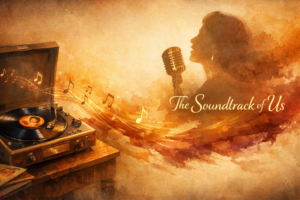
Have you ever been stuck in traffic, completely lost in a boring to-do list, when an old classic melody shuffles on? And suddenly—your entire mood shifts. You’re not staring at a red light anymore. You’re decades back, wrapped in a memory so vivid you can practically feel it.

With World Music Day just around the corner, I’ve been thinking a lot about this magic. It’s a day meant to celebrate how music transcends borders, but honestly, I love how it transcends time. For this week’s blog hop, I wanted to step away from the noise of the modern charts and talk about the real soundtrack of our lives—the music that actually has something to say.
When Lyrics Had a Soul
I should clarify that my musical universe is primarily rooted here at home; I have a deep sense of Indian music only. While the raw, acoustic beauty of folk songs from any country can easily touch my heart, I am honestly not much into contemporary Western music.
Instead, I find myself looking inward—and often struggling with today’s commercial tracks. So many modern Bollywood songs feel mass-produced, loud, and, let’s be frank, occasionally in quite bad taste. The emphasis seems to have shifted to heavy beats rather than heavy meaning.
For me, content is everything. That is why my heart permanently resides in the golden era of the 1950s and 1960s… I have to be honest here: I often find myself struggling with today’s music. So many modern Bollywood tracks feel mass-produced, loud, and, let’s be frank, occasionally in quite bad taste. The emphasis seems to have shifted to heavy beats rather than heavy meaning.
Back then, Bollywood didn’t just make songs; they crafted poetry. There was a song meticulously written for every single human emotion, every subtle mood, and every unspoken feeling. Whether it’s the timeless, versatile magic of Asha Bhosle or the unmatched, soulful warmth of Mohammed Rafi, those voices didn’t just sing lyrics—they told stories.
From Filmy Classics to the Depth of Ghazals
Beyond the silver screen, my ultimate sanctuary has always been the ghazal. There is a quiet, meditative dignity in a ghazal that you simply cannot find anywhere else.
Listening to Jagjit Singh is like receiving a warm hug on a lonely evening; his voice carries a soothing, melancholic depth that forces you to pause and just breathe. And while I love the veterans, I do find that same rare, emotional gravity in Arijit Singh today—he is one of the few modern voices who truly understands how to sing from the soul and honour the lyrics.
There’s a beautiful, scientific link between music and memory. I might forget where I kept my glasses five minutes ago, but play a song from the 60s? I can recite every single couplet, remember the exact rhythm, and feel the exact emotion I felt years ago. Our brains don’t just store melodies; they anchor our life chapters to them.
“Music is the shorthand of emotion.” — Leo Tolstoy
What’s Playing on Your Timeline?
As I sit here writing this at Neerja’s Musings, I have a vintage playlist softly humming in the background. It made me realise that we don’t just measure our lives in years or milestones. We measure them in melodies.
So, let’s kick off the World Music Day celebrations with a bit of nostalgia.
If you had to pick just one song or ghazal that holds a piece of your past hostage—a melody that instantly takes you to a beautiful place—what is it? Are you a fellow lover of the golden retro era, or does a particular soulful voice speak to you?
Tell me your favourite track (and the memory attached to it) in the comments below. Let’s swap some stories and build a beautiful community playlist together.
This post is a part of ‘Mixtape Mood Blog Hop’ hosted by Manali Desai and Sukaina Majeed under #EveryConversationMatters blog hop series
Neerja Bhatnagar
Feel free to connect with me on social media to stay updated on more content like this!
Instagram | Facebook | YouTube |Twitter |Podcast |
I have written 3 solo books and 3 anthologies. You can buy my books on Amazon. If you are on Kindle Unlimited, you can read them for free. Pls, do check and share your reviews.
As a millennial my heart immediately goes to music an songs from the 90s, especially Hindi songs. My father used to play songs every morning to wake us and then keeping it on as we got ready and both our parents helped send us off to school. Core memories with the songs of that era 🙂
I’m deeply attached to the golden retro era because the rhythm of the raags really bring you closer to the life we are living.
A delightful read. Music has an extraordinary way of turning ordinary moments into lifelong memories
Thanks Neha!
Old songs for me hold all the meaning and importance. I grew up listening to some of the most beautiful songs on Vividh Bharti and that experience is something I wish every kid could get today.
The first time I saw the mountains is associated with the song Saanson ki zaroorat from Aashiqui. Because at that time this song was playing in the car.
Oh yes! I agree with you old music holds a high place in my heart, and will always do so. Ghazals do come somewhere on top of my list, too. While old hindi movie tracks are an all-time favourite, my top favourite musician is Ilayaraja. I love old Kannada and Tamil songs the most.
Lovely nostalgic post on music. Enjoyed reading it.
Thanks Ratna!
You have tickled an old memory nerve for me. A playful debate between me and my masi, where she said new music is only loud without any sense to it. And after a general, I say the same thing to my son, today’s music is senseless, look at lyrics of old one’s. My flavour Jagjit Singh is koi fariyaad from the movie Tum Bin.
:)!
This is how generational taste moves on!
I’m also a fan of old songs. My collection has songs from 70s, 80s, and a few from 90s. They carry depth of meaning, as you’ve already said. Present-day music is more noise than art. And the lyrics, nothing said is better.
Very true!
I am also a fan of the music of the ’50s and the ’60s. In fact, when i am cooking, I ask Alexa to play gems by Mohd. Rafi, Hemant Kumar and Geeta Dutt. The lyrics those days were so meaningful and the singing simple, yet exquisite!
Jagjit Singh’s Kaagaz Ki Khashti is one of my favourite songs, as is Maa from Taare Zameen Par.
Ahh.. we have so much similar choices!
I agree old songs had beautiful poetry, the lyrics were a treat to listen to. That’s missing now. The stress is on rhythm and beats oh and rap, which I heartily dislike. It’s hard to pick a favourite song. I love most of the music from the 60s and 70s.
Totally agree!