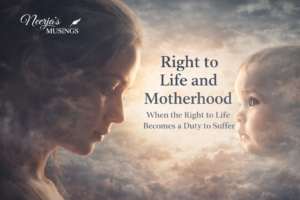
 When the Right to Life Becomes a Duty to Suffer
Some newspaper articles don’t leave you after the morning tea is over. They sit quietly in a corner of your mind, like an old song playing from another room. I recently read (in the Indian Express) an opinion piece titled “Right to life cannot mean duty to reproduce suffering.” It explored a deeply uncomfortable question — one that society often avoids because it disturbs the neat little stories we like to tell ourselves about family, motherhood, and morality.
What if bringing a child into the world is not always an act of love? What if, sometimes, it is the beginning of inherited suffering? The article referenced the Lebanese film Capernaum, where a 12-year-old boy sues his parents for giving him birth into misery. That single idea shakes something inside. Because in our culture, birth is automatically celebrated. We rarely pause to ask what kind of life waits beyond that celebration.
A child needs more than a heartbeat. A child needs safety, dignity, emotional security, and a reason to feel wanted. And yet, for generations, society has treated reproduction almost like a compulsory milestone. Study. Marry. Have children. Keep the cycle moving. Questions were considered rebellion. Doubt was selfishness.
But times are changing. Women today are asking difficult questions — not because they hate motherhood, but because they understand its weight. Is every woman meant to be a mother? Is every pregnancy a blessing? Can an unwanted birth leave emotional scars on both mother and child?
Recently, the Supreme Court of India permitted the termination of a pregnancy beyond 24 weeks in the case of a minor rape survivor. The decision was not merely legal; it was humane. The Court chose to look at the young girl’s future life rather than reducing her existence to a moral slogan. That matters.
Because motherhood is not just biological. It is psychological, emotional, spiritual, and financial — all at once. Romanticising sacrifice has been one of society’s oldest habits. Women have long been taught that enduring pain silently is a virtue. But silent suffering does not automatically become noble.
Sometimes compassion means protecting life. Sometimes compassion means preventing lifelong trauma. This is where the debate becomes deeply personal and deeply philosophical. Many people oppose abortion on moral or religious grounds, and their concerns come from genuine beliefs about the sanctity of life. Others argue that forcing motherhood upon someone is itself a form of violence.

Between these two positions lies a truth we often ignore — life is not merely existence. A life filled with neglect, resentment, abuse, fear, or emotional abandonment cannot be glorified simply because it began. The modern world is strange in its contradictions. We celebrate babies online with filtered photographs and poetic captions, yet many children grow up emotionally unseen. We talk endlessly about “family values,” but rarely about mental health inside families. We praise motherhood, but often leave mothers exhausted, unsupported, and lonely.
The older generation believed in endurance.
The newer generation believes in questioning.
Perhaps wisdom lies somewhere in between.
Not every birth is a miracle. Not every sacrifice is sacred. And not every continuation of life is an act of kindness. Sometimes the bravest thing a society can do is stop treating motherhood as destiny and start treating it as a deeply conscious choice because the right to life should never become a lifelong sentence to suffering.
What are your thoughts on this difficult conversation? Do you believe every birth is sacred, no matter the circumstances, or should compassion sometimes mean making painful choices? Share your views respectfully in the comments. At Neerja’s Musings, every perspective is welcome — because honest conversations are where understanding begins.
Neerja Bhatnagar
Feel free to connect with me on social media to stay updated on more content like this!
Instagram | Facebook | YouTube |Twitter |Podcast |
I have written 3 solo books and 3 anthologies. You can buy my books on Amazon. If you are on Kindle Unlimited, you can read them for free. Pls, do check and share your reviews.