
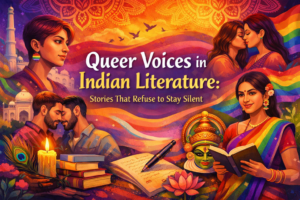
June is celebrated worldwide as Pride Month—a time to acknowledge, celebrate, and support the LGBTQIA+ community. While discussions around gender identity and sexual orientation often seem modern, the truth is that diversity in love, identity, and expression has always existed. What has changed is our willingness to talk about it openly.
As a reader and writer, I often believe that literature is one of the most powerful mirrors of society. It reflects not only who we are but also who we have overlooked. This Pride Month, I wanted to explore how Indian literature has given voice to queer experiences and why these stories matter.


Were Queer Identities Always Part of Indian Culture?
One common misconception is that LGBTQIA+ identities are a Western concept. A look at Indian mythology, history, and literature tells a different story.
Ancient Indian texts contain numerous references to gender fluidity and diverse expressions of identity. The character of Shikhandi in the Mahabharata challenges traditional notions of gender. Arjuna’s year as Brihannala presents another fascinating example of gender transformation. Various regional traditions and folk narratives also acknowledge identities beyond the male-female binary.
These stories suggest that Indian culture historically possessed a more nuanced understanding of gender and identity than we often assume today.
Literature as a Window into Lived Experiences
Modern Indian literature has played an important role in bringing queer experiences out of the shadows and into public conversation. For decades, LGBTQIA+ individuals often lived invisible lives. Their stories were either ignored, misunderstood, or portrayed through stereotypes. Contemporary Indian writers have helped change that narrative. Their works explore themes of love, loneliness, acceptance, family expectations, discrimination, self-discovery, and resilience. More importantly, they remind readers that queer individuals are not “issues” to be discussed but human beings with dreams, fears, relationships, and aspirations.
Voices That Deserve to Be Heard
A. Revathi
One of the most significant voices in Indian queer literature, A. Revathi’s memoir The Truth About Me offers a deeply personal account of life as a transgender woman in India. Her writing provides readers with an honest glimpse into struggles for acceptance, dignity, and identity.
R. Raj Rao
Through novels such as The Boyfriend, R. Raj Rao explores gay identity in urban India. His work is among the earliest Indian English fiction to address queer relationships with openness and sensitivity.
Devdutt Pattanaik
Known primarily for his work on mythology, Pattanaik has highlighted how Indian myths and traditions contain numerous examples of gender diversity and same-sex relationships. His writings challenge the belief that queerness is somehow foreign to Indian culture. For readers who wish to delve deeper into queer themes in Indian mythology, Devdutt Pattanaik’s Shikhandi and Other Queer Tales They Don’t Tell You is an excellent starting point. The book brings together stories from Hindu mythology and folklore that reflect gender fluidity and diverse expressions of identity. His novel The Pregnant King also explores complex questions of gender and selfhood, reminding us that such conversations are not new to Indian thought and storytelling.
Emerging Voices
Today, many young Indian authors are creating stories where queer characters exist not as side notes but as central protagonists. These stories are appearing in novels, memoirs, poetry, graphic narratives, and digital platforms, helping broaden representation.
Why Representation Matters
Imagine growing up without ever seeing someone like yourself in books, films, or media.
Representation matters because stories shape our understanding of the world. When literature includes diverse identities, it helps readers develop empathy and understanding. For members of the LGBTQIA+ community, representation can also provide validation and hope. A well-written story has the power to replace stereotypes with understanding and prejudice with compassion.
One Stereotype I Refuse to Carry
If there is one stereotype I refuse to carry, it is the belief that LGBTQIA+ people are somehow different from the rest of us in their fundamental human needs. Like everyone else, they seek love, belonging, respect, safety, friendship, and acceptance. Identity may differ. Humanity does not.
How Can We Be Better Allies?
Being an ally does not always require grand gestures. Often, it begins with simple actions:
- Listening without judgment.
- Respecting people’s chosen names and pronouns.
- Challenging stereotypes when we encounter them.
- Creating spaces where everyone feels welcome.
- Reading diverse stories and broadening our understanding.
Change begins with awareness, and awareness often begins with stories. Literature has always been a bridge between different worlds. Queer voices in Indian literature invite us to cross that bridge—not merely to observe different lives but to understand them. These stories remind us that diversity is not a threat to society; it is part of the rich tapestry that makes society human.
This Pride Month, perhaps the most meaningful thing we can do is read with open minds and compassionate hearts. Because every story deserves to be told, and every voice deserves to be heard.
When we make room for every story, we create a world where everyone belongs.
This post is powered by Blogchatter Blog Hop.
Neerja Bhatnagar
Feel free to connect with me on social media to stay updated on more content like this!
Instagram | Facebook | YouTube |Twitter |Podcast |
I have written 3 solo books and 3 anthologies. You can buy my books on Amazon. If you are on Kindle Unlimited, you can read them for free. Pls, do check and share your reviews.