
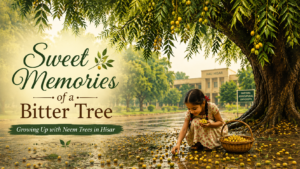
 Sweet Memories of a Bitter Tree: Growing Up with Neem Berries
Some childhood memories refuse to fade, no matter how many decades pass. They return quietly, often triggered by something as simple as an article, a familiar fragrance, or the sight of an old tree.
Today, reading about the health benefits of neem berries, or nimboli, took me straight back to my childhood in Hisar, Haryana.
We lived on the campus of Haryana Agricultural University (HAU), a place that was more than just an educational institution. It was a green paradise. Wide roads lined with towering trees, sprawling fields, chirping birds, and nature at its generous best. Among the many trees that stood proudly across the campus, the neem tree was everywhere.
Come summer and the arrival of the monsoon, the neem trees would be laden with tiny green berries that slowly turned yellow. During rain showers and dust storms, hundreds of these little fruits would carpet the ground. We children would rush out after the rain, gathering the freshest ones before they disappeared under our playful feet.


The funny part? The leaves of the neem tree were famously bitter. Yet the ripe nimbolis were surprisingly sweet. As children, we never questioned nature’s magic. We enjoyed it. Today, I often wonder how a tree known for its intensely bitter leaves could produce such delightfully sweet fruit. Perhaps nature likes reminding us that sweetness often hides behind a rough exterior. Maybe it is one of life’s earliest lessons.
Back then, we never ate nimbolis because they were healthy. We had no idea they were rich in antioxidants or that they supported immunity, digestion, and healthy skin. We ate them because they tasted good, and because they were part of our everyday world.
Modern science now confirms what our grandparents always believed—many traditional foods and natural remedies carry remarkable health benefits. Neem has long been respected in Indian households for its medicinal properties. Every part of the tree has found a place in Ayurveda, from its leaves and bark to its flowers, seeds, and berries.
But for me, nimboli is much more than a superfood. It is the laughter of childhood friends. It is muddy slippers after the first monsoon shower. It is pockets filled with tiny yellow berries. It is a campus where nature was our playground and every season brought its own treasures. Life today is faster. Children know more about packaged snacks than seasonal fruits growing on neighbourhood trees. Many may never experience the simple joy of picking fruit from the ground after a rainstorm or tasting something directly gifted by nature.
Whenever I see a neem tree now, I don’t first think of its medicinal value. I think of Hisar. I think of HAU. I think of carefree afternoons, monsoon winds, and those unexpectedly sweet nimbolis that taught me, without saying a word, that appearances can be wonderfully deceptive.
Sometimes, the sweetest memories really do grow on the bitterest trees.
Did you ever eat nimboli as a child? I’d love to hear your memories. Share them in the comments—let’s take a nostalgic walk down memory lane together.
Neerja Bhatnagar
Feel free to connect with me on social media to stay updated on more content like this!
Instagram | Facebook | YouTube |Twitter |Podcast |
I have written 3 solo books and 3 anthologies. You can buy my books on Amazon. If you are on Kindle Unlimited, you can read them for free. Pls, do check and share your reviews.
Sweetness lies hidden inside the bitter exterior. Thanks for that Sunday thought.
Thanks !