
The Freedom Trail of Ahmedabad: Walking Through India’s Independence Story
Ahmedabad is often described as a city of textiles, trade, food and heritage. But there is another story woven deeply into its streets—the story of India’s freedom struggle.
Long before the Sabarmati Riverfront became a favourite evening destination, before Ahmedabad became a bustling modern metropolis, the banks of the Sabarmati witnessed conversations, prayers, protests, experiments and decisions that helped shape India’s struggle for independence.
Mahatma Gandhi chose Ahmedabad as the home of his first ashram in India. From here, he experimented with satyagraha, worked with mill workers and farmers, built institutions, communicated his ideas through newspapers, and finally walked out of Sabarmati Ashram in 1930 to begin the historic Dandi March.
And Gandhi was not alone.
Ahmedabad was also the city of Sardar Vallabhbhai Patel, a powerful organiser whose work transformed Gujarat’s participation in the national movement.



Ahmedabad played a remarkable role in India's independence movement.
Walk through its Freedom Trail and discover the places connected with Gandhi, Sardar Patel,
satyagraha and the Dandi March.
Today, we can still trace many of these stories.
Welcome to the Freedom Trail of Ahmedabad.
1. Kochrab Ashram: Where Gandhi’s Indian Journey Began
Our freedom trail should begin at Kochrab Ashram, because this is where Gandhi established his first ashram in India. On 25 May 1915, just months after returning to India from South Africa, Gandhi established the Satyagraha Ashram at Kochrab.
Why Ahmedabad?
Gandhi himself explained that he had a special inclination towards Ahmedabad. He believed that as a Gujarati he could serve the country effectively through the Gujarati language. He also saw Ahmedabad’s tradition of handloom weaving as an ideal environment for reviving spinning and cottage industries.
The choice turned out to be historic. The Kochrab Ashram was not simply a residence. Gandhi and his companions experimented with the principles that would later become central to his public life—truth, non-violence, self-discipline, manual labour, simplicity and service.
There was even an early test of Gandhi’s commitment to social equality. When he admitted a Dalit family into the ashram, financial support to the ashram dried up. Gandhi refused to compromise. Eventually, industrialist Ambalal Sarabhai provided financial help that enabled the ashram to survive.
What to look for: Gandhi’s and Kasturba’s rooms, the prayer space and the simple architecture of the ashram.
The building is modest. That is precisely the point. The man who would challenge an empire chose to begin with very little.
2. Sabarmati Ashram: The Heart of Gandhi’s Freedom Movement
From Kochrab, the ashram moved to the banks of the Sabarmati in 1917. Today, Sabarmati Ashram is probably the most famous stop on Ahmedabad’s freedom trail. Gandhi stayed at Sabarmati Ashram from 1917 to 1930, and during those years it became a major centre of India’s independence movement. This was where Gandhi lived an intentionally simple life while simultaneously engaging with some of the biggest political and social questions facing India.
From here he worked on:
- Satyagraha and non-violence
- Swadeshi and khadi
- India’s independence movement
- removal of untouchability
- rural development
- education
- social reform
- constructive work
The ashram also became a meeting place for many prominent figures of the national movement.
Hriday Kunj, Gandhi’s home, remains one of the most evocative places here. There is something powerful about standing in front of that tiny dwelling and remembering the scale of the struggle Gandhi was preparing to lead. The setting is quiet.
3. The Gandhi Smarak Sangrahalaya: Understanding the Man Behind the Mahatma
Within the Sabarmati Ashram complex is the Gandhi Smarak Sangrahalaya, designed by architect Charles Correa. This is the place to slow down. Instead of seeing Gandhi merely as the familiar figure on currency notes and school textbooks, the museum helps us encounter the man—his writings, ideas, correspondence, photographs and experiments. Gandhi’s years in Ahmedabad were a period of intense intellectual and personal development. The Gandhi Heritage Portal notes that he refined his ideas here around truth, non-violence, service, simplicity and public life.
One particularly interesting fact is that Gandhi wrote his autobiography in Gujarati during this period. It later became famous in English as The Story of My Experiments with Truth.
A visit here is therefore not simply a history lesson. It is an invitation to ask:
How does an ordinary human being become capable of influencing millions?
4. The Sabarmati River: The Starting Point of the Dandi March
Stand by the Sabarmati and imagine Ahmedabad on the morning of 12 March 1930. Gandhi, aged 61, walked out of the ashram with his carefully selected group of satyagrahis. The destination was Dandi. The weapon was salt. The journey would become one of the defining episodes of India’s freedom struggle. According to the Gandhi Heritage Portal, Gandhi set out at 6:30 in the morning with 78 satyagrahis. The march eventually covered about 385 kilometres.
Why salt?
Because salt belonged to everyone. Rich or poor, farmer or labourer, Hindu or Muslim—everyone needed it. By choosing something so ordinary, Gandhi transformed an everyday necessity into a symbol of resistance against British rule. The Salt March demonstrated the extraordinary power of turning an apparently small injustice into a national movement. And its first footsteps began right here in Ahmedabad.
5. The Ahmedabad Mill Workers’ Struggle: When Workers Joined the Movement
The freedom struggle wasn’t fought only in political meetings. It entered Ahmedabad’s textile mills too. In 1918, Gandhi became involved in a dispute between Ahmedabad’s mill owners and workers. The workers were demanding better wages. Gandhi supported their struggle and undertook a fast to maintain their resolve. The dispute eventually settled.
This episode is important because it was one of Gandhi’s early Indian experiments with non-violent collective action.
Ahmedabad’s textile industry therefore became part of the story of how Gandhi developed a method of protest that could involve ordinary working people. The freedom movement was beginning to move beyond educated elites and political organisations. It was reaching the streets, factories and homes of ordinary Indians.
6. Ahmedabad and the Kheda Satyagraha
The story of Ahmedabad’s freedom movement also reaches beyond the city’s boundaries. In 1918, Gandhi became involved in the Kheda Satyagraha, supporting farmers who were struggling after crop failure and demanding relief from land revenue. On 22 March 1918, Gandhi addressed around 5,000 peasants at Nadiad and urged them not to pay land revenue when their crops had failed to the required extent.
And this is where another great Ahmedabad connection becomes impossible to ignore: Vallabhbhai Patel.
The lawyer from Gujarat who would eventually become known as Sardar Patel emerged as one of the most important organisers of the movement. The Ahmedabad–Kheda connection reminds us that the city’s freedom story was never confined within municipal boundaries. Ahmedabad became a centre from which ideas and organisation travelled into the villages of Gujarat.
7. Gujarat Vidyapith: Education as an Instrument of Swaraj
In 1920, Gandhi helped establish Gujarat Vidyapith. The idea was revolutionary in its own quiet way. If India wanted freedom, Indians needed to build their own institutions. Education could not simply mean producing people for government jobs under British rule. It could also mean preparing citizens for self-rule. The Gandhi Heritage Portal records the establishment of Gujarat Vidyapith in October 1920 and its connection with the wider programme of Swaraj and social uplift. This is an important part of the freedom trail because it reminds us that the independence movement wasn’t merely about removing the British.
It was also about asking: What kind of India should we build after they leave? That is a question worth remembering even today.
8. The 1921 Ahmedabad Congress Session
In December 1921, Ahmedabad hosted the annual session of the Indian National Congress. It was not just another political gathering. The session was presided over by Hakim Ajmal Khan, while Sardar Vallabhbhai Patel served as chairman of the reception committee. Gandhi played a central role in the proceedings. The Congress discussed the possibility of launching full-scale civil disobedience if the British government did not respond to its demands. The session also reflected the growing importance of khadi and simplicity. Khadi was used for the pandals and tents, and khadi bags were sold to delegates. Gujarati men and women volunteered for Congress work.
Interestingly, the original site of the Congress session is no longer a grand monument. The land was later acquired by the Ahmedabad Municipality, and today the site is associated with Vadilal Sarabhai Hospital. That is one of the fascinating things about a historical trail. Sometimes the place looks completely ordinary. Only the story makes it extraordinary.
9. Sardar Vallabhbhai Patel: Ahmedabad’s Other Great Freedom Fighter
It would be impossible to tell Ahmedabad’s freedom story without giving Sardar Patel his rightful place. Patel’s relationship with Ahmedabad was deep and practical. He was not merely a political leader passing through the city. He worked in Ahmedabad’s municipal affairs, organised people, built political networks and became one of Gandhi’s closest colleagues. His organisational abilities were extraordinary.
During the Non-Cooperation Movement, Patel helped mobilise Gujarat. He also played a major role in fundraising for the Tilak Swaraj Fund and in building support for the Congress and national education. Today, the Sardar Vallabhbhai Patel National Memorial at Shahibaug offers another important stop on Ahmedabad’s historical circuit. It helps place Patel’s life and contribution within the larger story of India’s independence and nation-building.
Because the freedom struggle did not have only one hero. It required thinkers, organisers, workers, writers, lawyers, teachers, farmers and countless unnamed people.
10. The 1922 Trial of Gandhi
Another lesser-known chapter of Ahmedabad’s freedom history is connected with Gandhi’s arrest in 1922. Gandhi and Shankarlal Banker were arrested for articles published in Young India. The trial took place in Ahmedabad, and Gandhi was sentenced to six years’ imprisonment. The episode illustrates something important about Gandhi’s approach to the freedom struggle. He did not simply resist British laws. He openly challenged laws that he considered unjust—and was prepared to accept the punishment imposed for breaking them. That acceptance of consequences was central to his understanding of satyagraha. Civil disobedience, in Gandhi’s philosophy, was not an excuse for lawlessness. It was an act of conscience.
A Suggested Ahmedabad Freedom Trail
If you want to experience these stories yourself, don’t try to rush through them all in one afternoon. Instead, think of the trail as a journey through different stages of India’s freedom movement.
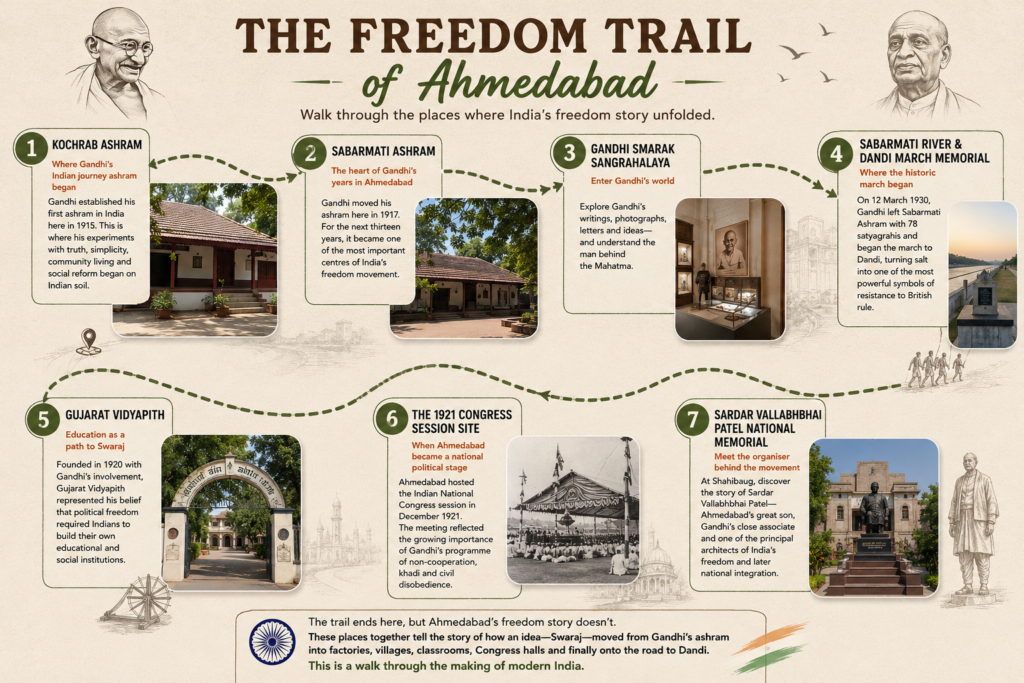
When we think about India’s independence movement, our minds naturally travel to Delhi, Mumbai, Kolkata, Amritsar, Dandi and countless other places. But Ahmedabad deserves a special place on that map. This was the city Gandhi chose when he returned to India. It was where he established his first ashram. It was where he worked with textile workers. It was closely connected with the Kheda Satyagraha. It was where institutions such as Gujarat Vidyapith emerged. It hosted a crucial Congress session.
And, most famously, it was where Gandhi picked up his walking stick, left Sabarmati Ashram and began walking towards Dandi.
That is why the Freedom Trail of Ahmedabad is not merely a collection of monuments.
It is a story of ideas becoming action.
Truth becoming satyagraha. Khadi becoming a political statement. Salt becoming a weapon of resistance. Ordinary people becoming participants in history. And a quiet ashram on the banks of a river becoming one of the most recognisable starting points of a nation’s journey towards freedom. Perhaps the best way to experience Ahmedabad’s freedom trail is therefore not as a tourist.
Walk slowly.
Look carefully.
Read the inscriptions.
Sit quietly for a few minutes.
And remember that the freedom we inherited was once only an idea in the minds of people who were willing to sacrifice for it.
We may be living in a very different Ahmedabad today, but beneath the modern city runs an old river of history.
And once you know its story, you begin to see Ahmedabad a little differently.
Practical Note
Opening hours and visitor arrangements can change, so check the official information before making a dedicated heritage trip. The Gandhi Heritage Portal is particularly useful for researching the history of the Sabarmati and Kochrab Ashrams and Gandhi’s chronology.
Useful official resource
Neerja Bhatnagar
Feel free to connect with me on social media to stay updated on more content like this!
Instagram | Facebook | YouTube |Twitter |Podcast |
I have written 3 solo books and 3 anthologies. You can buy my books on Amazon. If you are on Kindle Unlimited, you can read them for free. Pls, do check and share your reviews.